
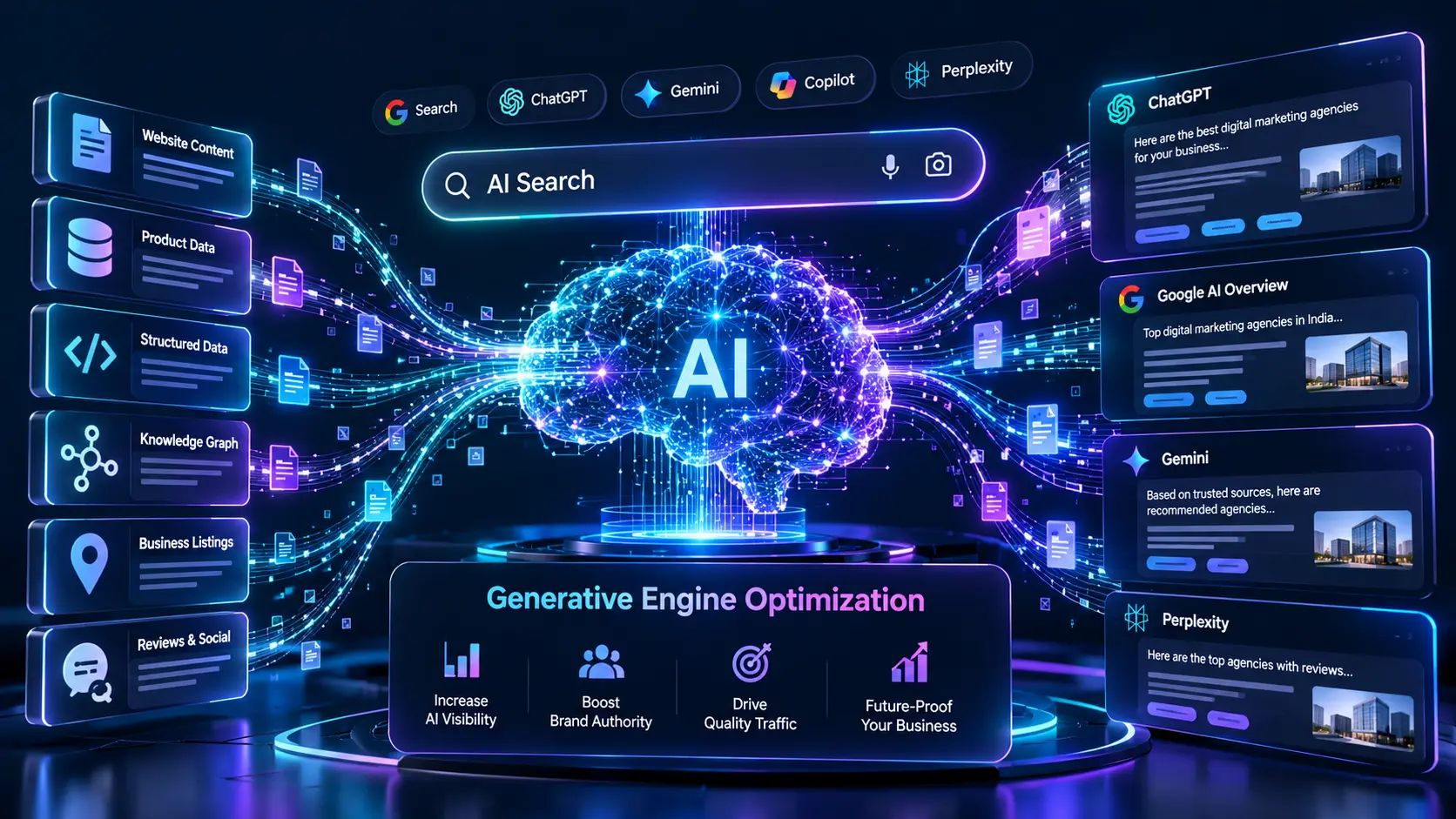
Generative Engine Optimization (GEO): How Businesses Can Win in AI Search (2026 Guide)
AI search engines and Google AI Overviews are changing organic discovery. Learn how Generative Engine Optimization (GEO) helps your brand get cited, recommended, and extracted as an authoritative source in 2026.
Search behavior has fundamentally shifted. Traditional search engine optimization focused heavily on winning blue links through keyword density and backlink acquisition. Today, generative engines like Google AI Overviews, ChatGPT, and Perplexity synthesize direct answers for users, turning search from a directory of links into an answer engine.
Generative Engine Optimization (GEO) is the strategy of optimizing digital content so AI language models can easily crawl, extract, and cite your business as a trusted authority. Winning visibility in 2026 requires transitioning from traditional keyword targeting to structural machine readability.
1. Structure Content for Direct AI Extraction
AI models do not browse web pages like human visitors. They parse HTML and classify topic entities based on guidelines outlined in Google Search Central, pulling discrete text blocks into synthesized answers. Content designed for AI discovery must prioritize structure over narrative build-up.
Lead with Direct Definitions: Place core definitions and direct answers within the first 50–100 words of a section using clear syntax like "X is a service that accomplishes Y by doing Z."
Adopt Scannable Headings: Organize topics logically using clean H1, H2, and H3 hierarchies. Each section should answer one specific sub-query or user intent.
Utilize Formatted Lists & Tables: Large language models show a 30% to 40% higher citation rate for pages that format processes, specifications, and comparisons into bullet points or tables.
2. Implement Deep Technical Schema Markup
Structured data acts as a direct translation layer between your web architecture and AI crawlers. Without explicit schema markup, AI engines must guess the relationships between your products, services, and brand identity.
{
"@context": "https://schema.org",
"@type": "Service",
"name": "Generative Engine Optimization (GEO)",
"provider": {
"@type": "Organization",
"name": "Bindzo 8 Private Limited",
"url": "https://bindzo8.com"
},
"description": "Comprehensive technical SEO and AI search optimization service to increase brand citations in AI Overviews."
}
Deploying Organization, Service, Article, and FAQPage JSON-LD blocks ensures AI crawlers correctly parse your core commercial offerings. If you need help setting this up, explore our SEO & Strategy Services.
3. SEO vs. GEO: Key Differences
While traditional SEO and Generative Engine Optimization share the ultimate goal of driving business visibility, their core mechanisms and success metrics differ significantly:
Primary Metric
Traditional SEO: Focuses on Organic Rank position and Click-Through Rate (CTR) from search engine results pages.
GEO: Focuses on Citation Frequency and Reference Share within AI-generated responses and summaries.
Target Audience
Traditional SEO: Designed to align with traditional search engine algorithms and human searchers browsing links.
GEO: Designed for AI retrieval systems, RAG (Retrieval-Augmented Generation) pipelines, and LLM synthesizers.
Content Format
Traditional SEO: Long-form articles and landing pages optimized around specific keyword density and search intent.
GEO: Structured, answer-first content blocks, clear entity relationships, and highly scannable takeaways.
Authority Signals
Traditional SEO: Driven heavily by domain authority, backlink profiles, and anchor text distribution.
GEO: Driven by brand entity consistency across the web, structured schema markup accuracy, and factual consensus.
4. Technical Crawlability & Rendering Fundamentals
If AI bots cannot execute or read your HTML layout instantly, your business remains invisible in generated results.
Avoid Heavy Client-Side Rendering: Content loaded purely through JavaScript execution often gets ignored by lightweight AI crawlers. Ensure critical copy renders directly in server-side HTML through custom web development designed for speed and crawlability.
Audit Robots Directives: Verify that your
robots.txtallows access to key user agents like GPTBot and Google crawlers.Eliminate Content Behind Walls: Accordions, hidden tabs, and unindexed script layers limit the content AI models can extract.
Elevate Your Brand's Search Visibility with Bindzo 8
Adapting your website to the AI search era requires a modern mix of technical site performance, structured data architecture, and conversion-focused UI design.
At Bindzo 8, our team designs high-performance websites, custom web applications, and scalable SEO/GEO strategies engineered to maximize search authority and customer acquisition.
Contact our team today to request a complete site audit and prepare your business for the future of AI discovery.